When the Chain Snaps: Storm-0558
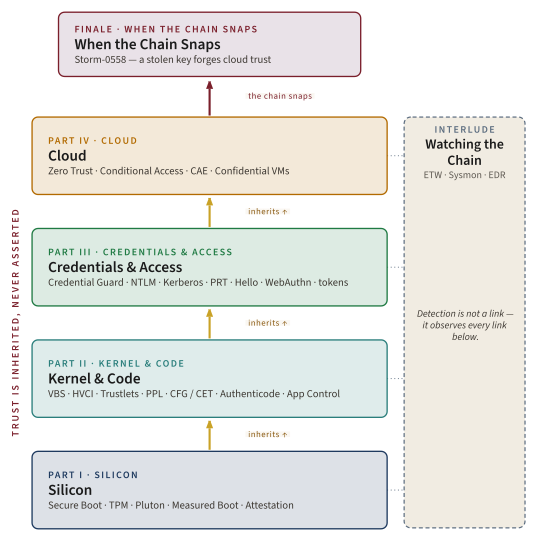
- Inherits: A session that can be revoked mid-life the moment risk changes (Chapter 27, Continuous Access Evaluation); explicit per-request verification that never implicitly trusts the network (Chapter 26, Zero Trust). Both standing on every link below them, from silicon measurement (Chapter 4, Measured Boot; Chapter 5, Attestation) to long-term secrets held off the box (Chapter 15, Credential Guard). Every inherited guarantee assumes the token under evaluation came from the right issuer, for the right audience, under a signing key still in the identity provider's custody.
- Promise: An enterprise resource accepts an access token only when its
issnames that tenant's own issuer and itsaudnames that resource, so a signature from the consumer Microsoft Account issuer can never authorize enterprise mail. Serviced boundary: the relying-party validation step that separates cryptographically authentic from authorized for this resource. - TCB: Custody of the MSA signing key; the key-rotation lifecycle that should have retired a 2016 key; and the relying-party issuer/scope/tenant enforcement Microsoft said the mail path failed to add, with RFC 8725's
iss/audchecks as the general JWT floor. All three were Microsoft's to keep correct; all three failed at once. - Adversary → Break: Storm-0558 held a stolen 2016 MSA consumer signing key (mechanism still unknown), forged an OIDC token naming a State Department mailbox, and Exchange Online/OWA verified the signature but did not enforce the issuer/scope/tenant boundary Microsoft later said the mail path had omitted. The Promise ends exactly where a valid signature was mistaken for an authorized one: the whole-chain failure this book has been building toward, in which one link inherited more authority than the link below it was meant to grant.
- Residual: How the 2016 key was stolen; the broader-blast-radius question; CSP-as-critical-infrastructure regulation; cross-provider unrotated-key risk; threshold/multi-party signing for production IdP keys; and customer-verifiable attestation of IdP key custody. Six gaps with no later chapter to own them → routed to the back-matter Unfinished Chain.
- Bequeaths: To the reader, not a next link. The book's thesis actualized: a trust chain fails not where it is weakest but where one link silently inherits more authority than the link below it was meant to grant, and the only repair is to isolate, rotate, narrow, record, and explain at every boundary. Does NOT provide: any guarantee the next signing-key theft is prevented. Prevention sits on the CSP side by construction, and the actual 2016-key theft path remains unknown.
- Proof: 🔵 documented throughout. Cyber Safety Review Board, Microsoft MSRC, CISA/FBI, and Wiz Research public record; no lab capture is possible for a historical cloud incident.
The Reasoner's question. When the chain snaps at cloud identity, which lower links still matter, which assumptions collapse, and what must a repaired chain prove differently?
Foundations. What you need before this chapter.
- MSA issuer vs. Entra ID issuer. Microsoft Account (MSA) is the consumer identity system for personal accounts such as Outlook.com, Live.com, Xbox, and personal “Sign in with Microsoft.” Microsoft Entra ID is the enterprise tenant-scoped identity system for workforce accounts. The MSA consumer tenant GUID is
9188040d-6c67-4c5b-b112-36a304b66dad; an enterprise tenant has a different tenant GUID. Same familiar host, different trust authorities. - Signing key. The private key an issuer uses to sign tokens. Whoever controls it can mint tokens whose signatures verify under the corresponding public key.
- JWT / OIDC access token. A signed token with a header, claims payload, and signature. Signature verification proves the bytes were signed by a key; authorization still requires validating issuer, audience, tenant, time, and scope.
kid. The key identifier in a JWT header. It selects the public key in the issuer's JWKS used for signature verification. It is not, by itself, proof that the issuer is authorized for the requested resource.issandaud. The issuer and audience claims. These are the checks that distinguish “a Microsoft key signed this” from “the right Microsoft issuer signed a token intended for this enterprise resource.”MailItemsAccessed. A Microsoft 365 Purview audit event for mailbox item reads. A State Department hunt through this event class surfaced the Storm-0558 activity.- CSRB. The Cyber Safety Review Board, a public-private federal review body established under Executive Order 14028. Its April 2024 Storm-0558 report called the intrusion “preventable” and said it “should never have occurred.”
In summer 2023, a stolen Microsoft consumer signing key from 2016 was used to forge cryptographically valid tokens that read the email of U.S. Commerce Secretary Gina Raimondo, U.S. Ambassador to China Nicholas Burns, Congressman Don Bacon (R-NE), and approximately 60,000 messages from State Department accounts. The cloud provider did not detect the breach: the State Department did, on June 15, 2023, by spotting an unfamiliar ClientAppID in Microsoft 365 Purview audit logs. Three years on, Microsoft cannot publicly explain how the key was stolen. The Cyber Safety Review Board called the intrusion "preventable" and Microsoft's security culture "inadequate"; Microsoft's Secure Future Initiative now custodies signing keys in hardware security modules and Azure Confidential VMs and validates 90% of Entra ID tokens for Microsoft apps with a hardened SDK: a four-for-four mapping to the four ways the pre-incident architecture failed at once.
A 2016 key that forged 2023 government email
On June 15, 2023, an analyst at the U.S. State Department's Security Operations Center was sifting through MailItemsAccessed events in Microsoft 365 Purview audit logs when something did not fit. A ClientAppID was reading mailboxes that did not match any application the State Department ran. The tokens that ClientAppID had presented to Exchange Online were cryptographically valid. They had been signed by a key Microsoft itself had published. Just not in 2023.
The consumer MSA key dated to 2016 and remained in place after Microsoft paused manual MSA key rotation following a 2021 rotation-related outage; in 2023 it was still accepted by the relevant validation path. Per Microsoft's own admission to the Cyber Safety Review Board nine months later, nobody at Microsoft can publicly tell you how Storm-0558 got hold of it [1316, 1208].
The State Department notified Microsoft on June 16, 2023 [1316]. The Cybersecurity and Infrastructure Security Agency was looped in within days. On July 11, 2023, Microsoft published its first public mitigation post, attributing the campaign to a China-based actor it called Storm-0558 and reporting that approximately 25 organizations were affected [1317]. Three days later, the Microsoft Threat Intelligence team published a longer technical analysis confirming the same actor had used "forged authentication tokens" beginning May 15, 2023 [1318].
🔵 DOCUMENTED, public-record quotation.
The Board finds that this intrusion was preventable and should never have occurred. The Board also concludes that Microsoft's security culture was inadequate and requires an overhaul.: Cyber Safety Review Board, April 2, 2024 [1316]
The plain English of what happened is this. Storm-0558 had stolen one private signing key. By the construction of Microsoft's identity infrastructure, that key was authoritative for the consumer-grade Microsoft Account (MSA) issuer: the same issuer that signs tokens for @outlook.com, @live.com, Xbox accounts, and personal applications. The actor used the key to mint OpenID Connect access tokens that named enterprise mailboxes as their target. Those tokens should not have been accepted by Exchange Online, because Exchange Online is an enterprise resource and the signing key was a consumer issuer's. But they were accepted.
Once accepted, they granted read access to the named mailboxes. For weeks, that access was active and uninterrupted. The Cyber Safety Review Board's final tally puts the harvest at approximately 60,000 emails from State Department accounts and a total of 22 enterprise organizations along with approximately 503 related personal accounts [1316]. Identified individual victims include U.S. Commerce Secretary Gina Raimondo, U.S. Ambassador to China Nicholas Burns, and U.S. House of Representatives accounts that publicly include Congressman Don Bacon (R-NE) [1316].
Definition, Signing-key forgery.
A class of attacks in which an adversary obtains an identity authority's private signing key and uses it to mint cryptographically valid credentials (tokens, tickets, or assertions) that no downstream defender can distinguish from those issued by the legitimate authority. MITRE catalogs the technique family as T1606, "Forge Web Credentials," with sub-techniques for web cookies (T1606.001) and SAML tokens (T1606.002) [1360, 1361].
Four facts about this incident are what make it architecturally important, and each is a separate failure with its own remediation path. The first is that the stolen key was seven years old: a 2016 consumer MSA signing key left in place after manual MSA rotation was paused following a 2021 rotation-related outage, and still validating in 2023 [1316]. The second is that the validator on the enterprise side accepted a token signed by the wrong issuer for an enterprise resource. The third is that the cloud provider did not detect the breach: a paying customer did, on routine threat-hunting against an audit log the customer had to pay extra to collect. The fourth, perhaps most uncomfortable, is that the cloud provider does not know how its own root signing secret was stolen.
Name the four failure domains precisely, because the rest of the chapter is an exercise in not letting them blur into one another.
- Custody domain. The key existed in a software-signing environment whose failure modes included memory, crash dumps, debugging movement, and privileged operational access. HSM custody would not have made theft impossible, but it would have changed the theft from "copy key bytes" to "obtain use of a signing oracle inside a controlled boundary." That is a qualitatively different attack.
- Rotation domain. A 2016 MSA key stayed accepted because manual MSA rotation was paused after a 2021 rotation-related outage and automated rotation had not yet replaced it [1316]. The mistake was not a certificate-expiry story in which a date on a certificate magically kept granting authority. The operative failure was that the trust system still treated the 2016 key as valid years after its creation because the MSA rotation program had stalled.
- Validation domain. Exchange Online/OWA accepted a token whose signature verified under an MSA key without enforcing the issuer/scope/tenant boundary Microsoft says the mail path was responsible for adding. This is the domain where cryptography was working and authorization was not.
- Detection domain. The provider's own telemetry did not surface the campaign first. A customer with paid audit logs did: as the ETW and logging chapter (Chapter 25) warned. That made logging policy part of the incident, not an after-action footnote.
Those domains are independent enough that any one could have broken the chain in isolation. HSM custody might have prevented the key theft. Automatic rotation might have retired the 2016 key before 2023. Strict issuer/scope/tenant enforcement (with iss and aud validation as the general JWT floor) would have made the stolen consumer key useless against enterprise mail. Universal MailItemsAccessed logging might have shortened dwell time even after all the preventive controls failed. Storm-0558 is historically important because none of the four independent stops stopped.
Microsoft published a hypothesis in September 2023 (a crash dump exfiltrated through a compromised engineering account) [1208], partially walked it back in March 2024 ("we have not found a crash dump containing the impacted key material") [1208], and three weeks later the CSRB concluded definitively: Microsoft "does not know how or when Storm-0558 obtained the signing key" [1316].
Side note.
The "Storm-0558" name is Microsoft's. Microsoft adopted a weather-themed taxonomy on April 18, 2023, in which Storm-NNNN denotes a developing actor pending attribution and family names like "Typhoon" indicate origin: in this case, China [1319]. After attribution work matured, Microsoft renamed the group "Antique Typhoon" in August 2024 [1318].
Each of those four facts is the closure of a separate architectural failure, and each is fixable in isolation. So how did all four fail at once? That answer begins with where the attack class came from, and why it had been written about for six years before it caught the State Department's attention.
The lineage of signing-key forgery
Storm-0558 is not a novel attack class. The primitive it instantiates (steal an identity authority's signing secret, mint cryptographically valid tokens that no downstream defense can distinguish from legitimate ones) has a six-year published lineage and an even longer informal one. The most important word in the previous sentence is "lineage." Each generation widened the trust domain the forgery primitive defeats.
Storm-0558 is the cloud-provider generalization of a technique whose first formal name dates to November 2017, when Shaked Reiner of CyberArk Labs published a CyberArk Threat Research post titled Golden SAML: Newly Discovered Attack Technique Forges Authentication to Cloud Apps [1145]. Reiner named the technique deliberately, riffing on Benjamin Delpy's earlier "Golden Ticket" name for the Kerberos analog.
Walking the lineage forward in order from oldest primitive to Storm-0558 is the cleanest way to see what is genuinely new in 2023.
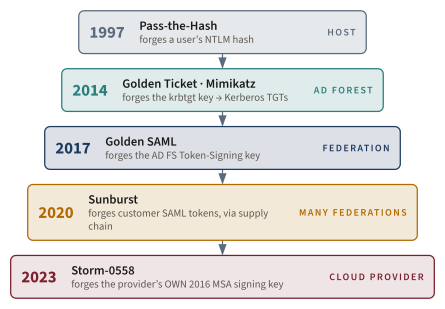
Generation one is Pass-the-Hash, first published as working exploit code by Paul Ashton on NTBugtraq in April 1997 (a modified Samba SMB client whose orig_client.c diff is dated Tue Apr 8 17:27:29 1997) [818] and described in Microsoft's own canonical whitepaper as the user-level baseline that all later generations replaced [619, 856]. The attacker captures the NTLM hash from a host they have already compromised and re-presents it to other Windows hosts; no password is recovered, no signing infrastructure is touched. Why a hash is a reusable bearer secret is owned by The Death of NTLM chapter (Chapter 16), and the full Pass-the-Hash-to-Pass-the-PRT arc by Chapter 19; the lineage here needs only the shape. The blast radius is a single Windows host or, when paired with lateral movement, a constellation of hosts that share a credential. The trust authority being attacked is the user account; the typical prerequisite is local code execution on a machine where the hash is cached, plus network access to the target.
Generation two is Golden Ticket, the Kerberos analog Benjamin Delpy's Mimikatz operationalized around 2014 [787, 1362, 1363]: the tool whose credential-theft decade is the subject of Chapter 14, and whose krbtgt-forgery mechanics the KRBTGT chapter (Chapter 18) owns in full. Where Pass-the-Hash forges user credentials, Golden Ticket forges Kerberos Ticket-Granting Tickets by signing them with the stolen krbtgt account's password hash from a domain controller. A forged TGT carries arbitrary PAC authorization data and SIDs, so the attacker can claim membership in any AD group, including Domain Admins. The blast radius widens from a host to an entire Active Directory forest. The trust authority being attacked is the forest's Key Distribution Center, and the prerequisite is extracting the krbtgt hash from a domain controller: a one-time theft that, until krbtgt is rotated, lets the attacker mint TGTs indefinitely. (That last clause is this chapter's rotation lesson, two generations early: a signing secret never retired becomes a skeleton key.)
Generation three is Golden SAML, the technique Reiner named in 2017 [1145]. The vector is the same shape: steal the AD FS Token-Signing private key, forge SAML assertions, present them to any cloud Service Provider federated to that AD FS. Quoting Reiner verbatim, the technique "enables an attacker to create a golden SAML, which is basically a forged SAML 'authentication object,' and authenticate across every service that uses SAML 2.0 protocol as an SSO mechanism." The blast radius widens again: from a single forest to every cloud Service Provider configured to trust that customer's AD FS: Azure, AWS, vSphere, and any SaaS in the customer's SSO catalog. CyberArk published a proof-of-concept tool, shimit, the same year [1146].
Side note.
The naming lineage is deliberate. Delpy's "Golden Ticket" was an explicit reference to the visual of unlimited, never-expiring access; Reiner's "Golden SAML" was equally explicit homage to Delpy. Reiner notes the connection openly in the original CyberArk post: "the golden SAML name may remind you of another notorious attack known as golden ticket, which was introduced by Benjamin Delpy who is known for his famous attack tool called Mimikatz" [1145]. Storm-0558 is the unnamed fifth generation.
Generation four is Sunburst, December 2020. The Russian Foreign Intelligence Service (SVR) compromised the SolarWinds Orion build pipeline, planted a backdoor in Orion updates, and from that initial-access foothold used Golden SAML against the federations of victim organizations to mint forged SAML tokens for Microsoft 365 and other federated SaaS [1321, 1364]. Microsoft itself was among the victims. The company's February 2021 final update acknowledged that SVR had accessed source code for "small subsets" of Azure, Intune, and Exchange components but found "no evidence of access to production services or customer data," and reported that the actor was not able to gain access to privileged credentials or apply the SAML forgery techniques against Microsoft's own corporate domains [1320].
The blast radius pattern of Sunburst was: one supply-chain compromise on the way in, then Golden SAML in each federation once inside. CISA attributed the SAML-token forgery technique explicitly in AA20-352A and named the SVR as the responsible actor in an April 2021 update to the advisory [1321].
Definition, Golden SAML.
A 2017 attack technique by which an adversary who possesses the AD FS Token-Signing private key forges SAML 2.0 assertions and authenticates as any user to any cloud Service Provider that federates with that AD FS. Cataloged by MITRE as T1606.002 ("Forge Web Credentials: SAML Tokens") and named by Shaked Reiner of CyberArk Labs in deliberate homage to Mimikatz's "Golden Ticket" [1361, 1145].
Generation five (the one this chapter is about) is Storm-0558. The earlier four generations had one structural property in common: the trust authority being forged was the customer's identity infrastructure. The customer's NT account database, the customer's domain controller, the customer's AD FS Token-Signing certificate, the customer's Orion-installed SolarWinds environment that fed those things. Sunburst, when it reached Microsoft, attacked Microsoft as a customer of its own corporate AD FS infrastructure. Storm-0558 attacked something different: the cloud provider's own consumer identity-provider signing key. The trust authority being forged was Microsoft's MSA issuer: the consumer-tier signing infrastructure that Microsoft itself operates as a service.
The blast radius of an attack of this shape is bounded only by where the relying-party validation libraries accept the cloud provider's issuer. In Storm-0558's case, as Wiz Research showed in independent analysis, the key could in principle have signed tokens accepted by Outlook.com, SharePoint, Teams, OneDrive, and any third-party multi-tenant application using Microsoft's converged v2.0 endpoint that accepts "Sign in with Microsoft" for personal accounts [1322]. The publicly documented exploitation was scoped to Exchange Online and Outlook Web Access, but, as Wiz's authors put it, "the compromised signing key was more powerful than it may have seemed" [1322].
So Storm-0558 is generation five in a chain whose earlier four generations had been documented, named, simulated, and operationalized for the better part of a decade. Sunburst still required compromising one customer's federation at a time. Storm-0558 compromised something different: Microsoft's own consumer identity provider. To understand how a consumer signing key could authenticate against an enterprise mailbox, we have to look at three architectural decisions Microsoft made between 2016 and 2022, and how they layered on top of a 2016 key left in place after rotation was paused.
The architecture before storm-0558
Two parallel Microsoft identity providers operate under one corporate roof. The first is the consumer Microsoft Account (MSA) issuer, which signs tokens for @outlook.com, @live.com, Xbox accounts, and the personal-account flavor of "Sign in with Microsoft." The second is the enterprise Microsoft Entra ID issuer (formerly Azure AD), which signs tokens for @contoso.com-style workforce identities under a per-tenant issuer URL. Each issuer has its own signing keys and its own JWKS endpoint: the public-key distribution endpoint that relying parties fetch to validate signatures.
These are separate systems with separate signing infrastructure, but the cross-tier distinction is finer than "different domains." Both the MSA and Entra ID issuers publish their v2.0 OpenID Connect tokens under the same login.microsoftonline.com host. What distinguishes them is the tenant GUID inside the issuer URL. The MSA "consumers" tenant has the well-known GUID 9188040d-6c67-4c5b-b112-36a304b66dad, so its v2.0 OIDC issuer is <https://login.microsoftonline.com/9188040d-6c67-4c5b-b112-36a304b66dad/v2.0> (verifiable live from the MSA OpenID Connect discovery document) [1323]. Every Entra ID enterprise tenant has its own tenant GUID, so its issuer is <https://login.microsoftonline.com/>{enterprise-tenant-GUID}/v2.0.
Microsoft's own July 11, 2023 disclosure put it plainly: "MSA (consumer) keys and Azure AD (enterprise) keys are issued and managed from separate systems and should only be valid for their respective systems. The actor exploited a token validation issue to impersonate Azure AD users and gain access to enterprise mail" [1317]. The architectural sentence to hold on to from that paragraph is should only be valid for their respective systems. How that should became did not is the architecture of the incident.
Definition: JSON Web Token (JWT).
A compact, URL-safe token format consisting of three Base64URL-encoded parts: a header (algorithm and key identifier), a payload (claims like iss (issuer), sub (subject), aud (audience), exp (expiration), nbf (not-before), and application-specific claims), and a signature over the header and payload. JSON Web Token Best Current Practices are codified in IETF RFC 8725 [1324].
Definition: JWKS and Key ID (kid).
JWKS is the JSON Web Key Set a token issuer publishes at a well-known URL. Each key in the set carries a kid (Key ID). The JWT header names a kid, and the relying party uses it to locate the matching public key from the issuer's JWKS for signature verification. RFC 8725 requires a validator to restrict which signing algorithms it will accept (Section 3.1) and binds the kid lookup to a specific issuer's keys, never to a global key namespace [1324].
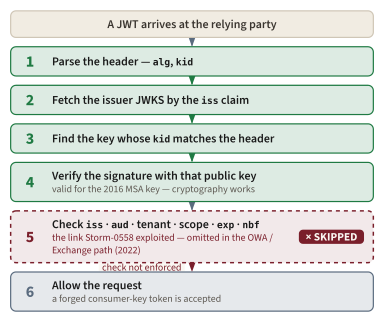
To understand the cross-tier flaw, walk a standard JWT validation flow in order. Step one: the relying party parses the JWT header to read the alg and kid. Step two: it looks up the issuer's JWKS using the iss claim from the payload (or a hard-coded issuer URL it trusts). Step three: it locates the public key whose kid matches the one in the header. Step four: it verifies the signature using that key.
Step five is the one that matters. The validator checks the payload claims: iss must match the trusted issuer for this resource, aud must match this resource's identifier, exp and nbf must bracket the current time, and any application-specific tenant or scope claims must be enforced [1324]. RFC 8725 (the IETF JWT Best Current Practices, published February 2020) makes step five mandatory; its Section 3.8 requires that "the application MUST validate that the cryptographic keys used for the cryptographic operations in the JWT belong to the issuer. If they do not, the application MUST reject the JWT." When step five does not happen, the entire validation reduces to "the signature is valid for some key the issuer signed something with," which is not the same as "the token authorizes the bearer for this resource."
Definition: Microsoft Account (MSA) vs Entra ID.
Microsoft Account is the consumer identity provider for @outlook.com, @live.com, Xbox, and personal-account "Sign in with Microsoft" flows. Its v2.0 OpenID Connect issuer is <https://login.microsoftonline.com/9188040d-6c67-4c5b-b112-36a304b66dad/v2.0>: the MSA "consumers" tenant on the shared login.microsoftonline.com host [1323].
Microsoft Entra ID (formerly Azure Active Directory) is the enterprise identity provider for tenant-scoped workforce identities like user@contoso.com, with per-tenant issuers of the form <https://login.microsoftonline.com/>{enterprise-tenant-GUID}/v2.0 on the same host. The cross-tier distinction is therefore tenant-GUID-vs-tenant-GUID inside the same v2.0 URL template, not domain-vs-domain. The two systems are operationally separate with separate signing keys, separate JWKS endpoints, and separate intended audiences [1317, 1323].
Now bring in the three architectural decisions that lined up to create Storm-0558's window.
The first decision, in September 2018, was that Microsoft published a converged metadata endpoint. Microsoft's own September 6, 2023 retrospective is explicit about the motivation: "To meet growing customer demand to support applications which work with both consumer and enterprise applications, Microsoft introduced a common key metadata publishing endpoint in September 2018" [1208].
The point of the converged endpoint was developer ergonomics. Build one app, use one validation library, accept users from @outlook.com and @contoso.com alike. Internally, the shared validation library would verify signatures against either issuer's keys, and was documented to expect that callers would add their own issuer and scope checks for resource-side authorization decisions.
Side note.
The September 2018 decision was a developer-experience choice, not a security choice. Microsoft was responding to demand for unified consumer/enterprise app flows. The validation library it shipped could check iss, but the design left that decision to the caller: under the (reasonable, at the time) assumption that each caller best understood which issuers should be acceptable for its resource. The flaw Storm-0558 exploited was not a bug in the library; it was a missing line in a caller five years later.
The second decision, in 2022, was that Microsoft's mail platform team migrated Outlook Web Access (OWA) and Exchange Online's token-validation code to consume that converged endpoint without adding the issuer and scope check the library expected callers to add. This is the point where a convenience boundary became a security boundary. A converged endpoint can be safe when the caller treats it as a catalog of possible issuers and then narrows the accepted issuer set for the resource. It becomes dangerous when the caller treats "the signature chains to a key from Microsoft's converged metadata" as equivalent to "this issuer is authorized for this mailbox."
The exact verbatim language from Microsoft's September 6, 2023 retrospective is worth quoting: "Developers in the mail system incorrectly assumed libraries performed complete validation and did not add the required issuer/scope validation. Thus, the mail system would accept a request for enterprise email using a security token signed with the consumer key" [1208]. Two systems, both built by Microsoft, with a shared interface contract that was undocumented at the precise boundary that mattered.
The third precondition, which is not strictly a 2018-or-2022 decision but rather a non-decision running through both, is that the 2016 MSA consumer signing key had never been rotated. The CSRB report is direct about why: "Microsoft automated the key rotation process in the enterprise system with the intent for the consumer MSA system to follow and use the same technology, but it had not done so in the consumer MSA system before the intrusion" [1316].
The MSA system had previously rotated keys manually. In 2021, the CSRB notes, Microsoft paused manual MSA rotation after a manual-rotation-related cloud outage, and the automated replacement never arrived. The 2016 key stayed live for seven years; after manual rotation paused in 2021, no automated MSA replacement retired it. Public JWKS history recovered by Wiz Research tied the kid to 2016-era MSA key material, and the CSRB record explains why that old key was still live: manual MSA key rotation had been paused after a 2021 rotation-related cloud outage, and automated MSA rotation had not yet replaced it [1322, 1316].
Key idea.
By 2022, the four preconditions for Storm-0558 were all in place. (1) A 2016 MSA consumer signing key left in place after rotation was paused. (2) Software-resident key custody (no HSM) for that key. (3) A 2018 converged metadata endpoint whose validation library left issuer/scope enforcement to callers. (4) A 2022 mail-platform migration onto that endpoint with the issuer/scope check missing. All that was needed was the attacker holding the key.
These three (or four, counting the implicit software custody) factors did not align by accident. Each was an independent decision, made for an independent reason, by people working in good faith on different timelines. Developer ergonomics in 2018, mail-platform consolidation in 2022, a paused rotation process in 2021. None of them was a security decision. None of them was a vulnerability when shipped in isolation.
The 2018 library would happily check iss if the caller asked it to. The 2022 mail platform would happily reject a consumer-key-signed token if the integrator had added the check. The unrotated key would not have mattered if either of the validation layers had enforced separation. Storm-0558 required all four to be wrong at once. They were.
The deeper lesson is that "converged" is a product word, not a security property. A converged endpoint can simplify sign-in across personal and work accounts, but it cannot decide which issuer is appropriate for a particular relying party. Only the relying party knows whether a State Department mailbox should accept the MSA consumers tenant. The endpoint can publish keys; the validator can verify signatures; the application must still answer the authorization question. Storm-0558 is the cost of moving that last question out of the application without moving the policy with it.
The attack chain, step by step
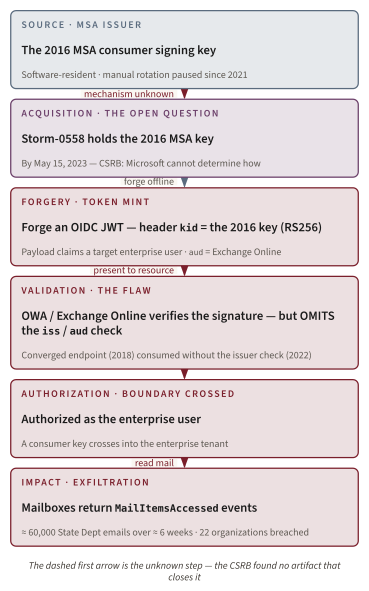
The attack itself happened in five operational stages. The forged-token activity began May 15, 2023 and continued until Microsoft invalidated the stolen key on June 24, 2023, after the State Department's detection on June 15 and notification to Microsoft on June 16 [1318, 1316]. That is roughly six weeks from first documented forged-token activity to the key's invalidation, with public disclosure following on July 11.
By the time the campaign was contained, Storm-0558 had been inside the cloud's identity infrastructure long enough to harvest tens of thousands of emails. What the attacker did is now mostly understood. What is not understood is how the attacker got the key in the first place.
1 Key acquisition (mechanism unknown)
What is known is that by May 15, 2023, Storm-0558 held a valid 2016 MSA signing key. What is unknown (and this is the most important sentence in the entire chapter) is how the actor obtained it.
Microsoft's September 6, 2023 retrospective offered a four-step hypothesis. A signing system crashed in April 2021. The crash generated a memory dump. The signing key was supposed to be redacted from such dumps, but a race condition allowed it through. The dump was supposed to remain inside an air-gapped production-isolated network but was migrated to the corporate debugging network. There, the credentials of a Microsoft engineer's account were compromised by an actor consistent with Storm-0558's tradecraft, and the dump was exfiltrated.
That was the September 2023 story.
The crash-dump story has been partially retracted by Microsoft itself.
Microsoft updated its September 6, 2023 retrospective on March 12, 2024 to add the following: "The blog below states that the actor access may have resulted from a crash dump in 2021, but we have not found a crash dump containing the impacted key material" [1208, 1365]. The artifact (crash dump containing the key) was not found. The general shape of the hypothesis (operational error plus compromised engineering account) is retained as the leading hypothesis (see the quotation immediately below for Microsoft's verbatim framing of what survives the retraction), not as a confirmed mechanism.
Three weeks after that retraction, the Cyber Safety Review Board published its report. The CSRB's finality on the question is uncompromising: Microsoft "does not know how or when Storm-0558 obtained the signing key" [1316]. The Board's investigation, which ran for seven months and drew on interviews with Microsoft engineers, the State Department, CISA, and independent reviewers, did not yield a confirmed mechanism. It identified candidate paths (crash-dump migration, debugging-environment access, a compromised engineering account) but found no artifact that closed any of them.
The epistemic shape of this finding deserves naming. Three years on, the cloud provider responsible for authenticating billions of users cannot publicly tell its customers how the most security-critical secret in its consumer identity stack was stolen.
That is not a minor footnote. As the architectural response below shows, it shapes Microsoft's entire architectural response: every Secure Future Initiative commitment about hardware-backed key custody, automatic rotation, and confidential signing has to defeat plausible mechanisms because the actual one cannot be enumerated.
🔵 DOCUMENTED, public-record quotation.
Our leading hypothesis remains that operational errors resulted in key material leaving the secure token signing environment that was subsequently accessed in a debugging environment via a compromised engineering account.: Microsoft Security Response Center, March 12, 2024 update to the September 6, 2023 Storm-0558 retrospective [1208]
2 Token forgery
With the private key in hand, forging an OpenID Connect access token is mechanical. The header names the algorithm Microsoft uses (RS256, RSASSA-PKCS1-v1_5 with a SHA-256 hash, in this case) and the kid of the 2016 key. The payload claims identify the target user (sub), the target tenant where applicable, the requested audience (Exchange Online's resource URI), and validity timestamps.
The actor signs the header-and-payload with the stolen private key, Base64URL-encodes the three parts, and joins them with periods. The result is a valid JWT, indistinguishable from one Microsoft itself would mint. Why? Because the cryptographic verification any relying party performs is, by construction, "does this signature verify under the public key whose kid is named in the header?"
That question is necessary and deliberately insufficient. A validator that stops at the signature has learned only that some private key corresponding to some public key produced the signature over these bytes. It has not learned that the signer is the right tenant, that the token was meant for Exchange Online, that the user belongs to the enterprise tenant named by the mailbox, or that a consumer issuer should ever be allowed to speak for a workforce account. JWT validation is therefore a two-stage act: cryptographic authenticity first, authorization semantics second. Storm-0558 lived in the gap between the stages.
The kid value is also easy to overread. A kid is a selector inside a key set, not a global identity. The same string has meaning only relative to the issuer and JWKS that published it. If a relying party lets a token point it to an issuer, fetches that issuer's keys, finds the kid, verifies the signature, and then never asks whether that issuer is acceptable for the resource, the attacker has successfully chosen the trust domain. RFC 8725 exists largely to prevent exactly that category error: bind the key lookup to a trusted issuer, and bind the issuer and audience to the resource [1324, 1366].
Storm-0558 forged tokens against both the legitimate MSA scope (Outlook.com mailboxes belonging to consumer accounts. The intended use of the 2016 key) and the illegitimate cross-tier scope (enterprise Exchange Online mailboxes belonging to organizations like the U.S. State Department, which were never the intended audience for an MSA-signed token). The legitimacy of the signature did not change between the two. The difference was on the relying-party side.
3 The cross-tier validation flaw
This is the bug. The OWA and Exchange Online code path that received an incoming token, parsed the header, fetched the public key from the converged metadata endpoint, and verified the signature did not, after a successful signature verification, separately enforce that the token's iss claim matched an issuer authorized for enterprise email.
The shared validation library was perfectly capable of performing the issuer check, but only if asked. The OWA/Exchange Online caller did not ask.
What 'cross-tier' means here.
A v2.0 MSA token's iss claim is <https://login.microsoftonline.com/9188040d-6c67-4c5b-b112-36a304b66dad/v2.0>: the MSA "consumers" tenant on the shared login.microsoftonline.com host, with the well-known consumers tenant GUID [1323]. A v2.0 Entra ID token's iss claim is <https://login.microsoftonline.com/>{enterprise-tenant-GUID}/v2.0, with the enterprise customer's own tenant GUID. The cross-tier distinction is tenant-GUID-vs-tenant-GUID inside the same URL template, not domain-vs-domain.
These are different issuers, with different signing keys and intended audiences. An enterprise resource like a State Department mailbox should accept only the second form, scoped to the State Department's tenant. Storm-0558's forged tokens presented the first form (the MSA "consumers" iss) for resources that should have accepted only the second. The validator did not notice the mismatch because it never read past the signature verification step.
The incident-specific fix is explicit issuer/scope/tenant enforcement on the relying-party side: the boundary Microsoft says the mail system failed to add. For JWT validators generally, RFC 8725 Sections 3.8 and 3.9 provide the corresponding floor: validate issuer and subject, and use and validate audience [1324, 1366].
The fix Microsoft eventually shipped is described in its own September 6, 2023 retrospective with the verbatim line "this issue has been corrected using the updated libraries" [1208].
Wiz Research, looking at the same flaw from outside, framed the architectural consequence. The actor's compromised key "could have theoretically used the private key it acquired to forge tokens to authenticate as any user to any affected application that trusts Microsoft OpenID v2.0 mixed audience and personal-accounts certificates" [1322]. The actual exploitation was scoped to email, but the addressable scope was larger.
The scope question is subtle. The public evidence proves Exchange Online/OWA exploitation. It does not prove Teams, SharePoint, OneDrive, or third-party application exploitation. But the architectural question Wiz raised is broader than the observed victim list: any application that accepted Microsoft's v2.0 mixed-audience model and failed to pin issuer/audience semantics tightly enough could have been in the theoretical blast radius. That is why the phrase "22 enterprise organizations" is the victim count, not the upper bound of what the key could sign. The key could sign wherever the relying party's validation discipline permitted it; the campaign we can document is only the subset that surfaced in mail telemetry.
Definition: Token signing key.
The private key an identity provider uses to sign authentication tokens it issues. Whoever holds the signing key can mint tokens cryptographically indistinguishable from those issued by the legitimate provider. The security of the identity system, in the absence of independent issuer/scope/tenant validation on the relying-party side, depends entirely on the custody of this key. The CSRB report describes its compromise as the central enabler of Storm-0558 [1316].
Definition: Issuer and audience (iss and aud) validation.
The check, performed by a JWT relying party after signature verification, that the token's iss claim matches a permitted issuer for the requested resource and the aud claim matches the resource's identifier. RFC 8725 codifies the combined obligation across two adjacent sub-sections: Section 3.8 ("Validate Issuer and Subject") makes iss and sub validation mandatory, and Section 3.9 ("Use and Validate Audience") makes aud validation mandatory [1324, 1366]. In Storm-0558, Microsoft described the omitted mail-system boundary as required issuer/scope validation; the general lesson is that signature validity alone must never substitute for resource-specific issuer, audience, tenant, and scope authorization.
Side note.
The function name GetAccessTokenForResource has been widely repeated across secondary coverage of Storm-0558 as the locus of the validation flaw. The name does not appear in any of the four primary sources: Microsoft's July 14, 2023 analysis, the September 6, 2023 retrospective, the CSRB report PDF, or the Wiz Research post. This chapter therefore describes the flaw functionally, as Microsoft itself did, without naming the function symbol [1208, 1316, 1322].
The missing enforcement class the OWA path needed to apply (and now does through updated libraries) is mechanical. In generic JWT relying-party pseudocode, the shape is exactly the post-signature issuer/resource check below:
4 Mailbox access and exfiltration
With validated tokens, the actor authenticated to Outlook Web Access and to Exchange Web Services as the target enterprise users. Once authenticated, the activity looked like any other authenticated user session: enumerate folders, fetch messages, read attachments.
Storm-0558 selected high-value targets. The CSRB final tally is, again, approximately 60,000 emails from State Department accounts; 22 enterprise organizations in total; approximately 503 related personal accounts [1316]. Named individual victims publicly include U.S. Commerce Secretary Gina Raimondo, U.S. Ambassador to China Nicholas Burns, and U.S. House of Representatives accounts including Congressman Don Bacon (R-NE), who confirmed in August 2023 that the FBI had notified him his personal and campaign email accounts were among those compromised [1316].
The campaign ran during what Microsoft characterized as China Standard Time business hours, with a working-hours heat-map pattern visible in the telemetry [1318]. The duration was at least six weeks of active access: from the attacker's earliest documented activity on May 15, 2023 until Microsoft invalidated the stolen key on June 24, 2023, eight days after the State Department's June 16 notification.
5 The broader blast radius (potential, not exploited)
Wiz Research's independent analysis published in mid-2023 made an argument the world had not yet absorbed. The same 2016 MSA signing key could in principle have signed OpenID v2.0 tokens for many more Microsoft services than just email. The Wiz authors enumerated SharePoint, Teams, OneDrive, and any third-party multi-tenant application supporting "Sign in with Microsoft" with mixed-audience personal-account acceptance [1322].
The framing they wrote ("if a signing key for Google, Facebook, Okta or any other major identity provider leaks, the implications are hard to comprehend") is the right framing [1322].
There is no public evidence that Storm-0558 exploited the broader scope. The breach the world saw is the breach Microsoft and CISA found by enumerating one specific service's logs. Whether the broader scope was exploited and not detected is, as discussed in the open problems below, an unanswered question.
That unanswered question should be read narrowly and rigorously. It is not license to inflate the incident into every Microsoft service. It is a reminder that detection is shaped by where investigators have logs. The State Department found mail access because it had MailItemsAccessed. A different resource would require a different high-fidelity event class, a different baseline, and a different hunt hypothesis. Absence of public evidence outside email is therefore meaningful but not dispositive.
Six weeks of access. Approximately 60,000 State Department emails. The cloud provider did not notice. So who did notice, and how?
Why a paying customer, not Microsoft, caught it
On June 15, 2023, the State Department SOC analyst who first noticed Storm-0558 was performing routine threat-hunting against Microsoft 365 Purview audit logs. The specific event type that surfaced the anomaly was MailItemsAccessed, an audit record that fires whenever a mailbox item is read or fetched. It captures who read it (UserId), from where (ClientIPAddress), with what application (ClientAppID, AppID), and against which item (InternetMessageId and folder).
The detection technique was a baseline-deviation check. The State Department maintained a list of legitimate (ClientAppID, AppID) pairs that historically read mailboxes belonging to its employees. Storm-0558's forged-token sessions presented AppID values that were not on the list.
On July 12, the day after Microsoft's public disclosure, CISA and the FBI published joint advisory AA23-193A formalizing what the State Department had done into a recommended detection methodology. The verbatim language in the advisory: "In Mid-June 2023, an FCEB agency observed MailItemsAccessed events with an unexpected ClientAppID and AppID in M365 Audit Logs.... The affected FCEB agency identified suspicious activity by leveraging enhanced logging (specifically of MailItemsAccessed events) and an established baseline of normal Outlook activity (e.g., expected AppID). The MailItemsAccessed event enables detection of otherwise difficult to detect adversarial activity" [1325, 1367].
Definition, MailItemsAccessed.
A Microsoft 365 audit event that records every read or fetch operation against a mailbox item. The event captures the user, source IP, client and application IDs, and the message identifier accessed. In this incident, the forged-token sessions surfaced through an AppID outside the State Department's normal application inventory, making MailItemsAccessed the highest-signal event class for this mailbox-token abuse pattern [1325].
Definition: Purview Audit (Premium).
A Microsoft 365 audit-log tier that, pre-July 2023, gated several high-value security event classes (including MailItemsAccessed) behind a paid add-on. Most federal civilian agencies and many commercial tenants were on Purview Audit (Standard) and did not collect these events. The State Department had paid for Premium and was therefore in a position to detect Storm-0558 from its own telemetry [1325, 1326].
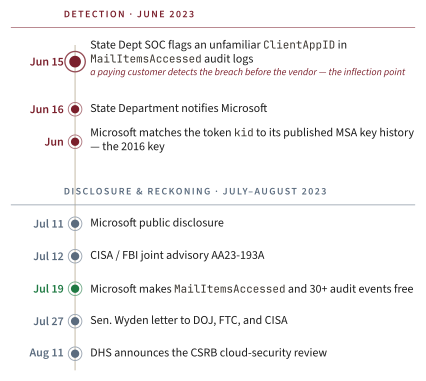
Microsoft's confirmation step came after the State Department's notification, not before. Once notified, Microsoft could compare the kid on the suspicious tokens against its own published MSA key history and found that the kid corresponded to the old 2016 consumer key [1322, 1318]. The signature was cryptographically valid for that key. The key should never have signed an enterprise-tier token. Both halves of that statement were true at the same time, and the second half is what told Microsoft this was a key compromise rather than a stolen-credential issue.
The structural fact about this detection (the one that puts every other event in this chapter in its proper context) is that MailItemsAccessed was, pre-incident, a Purview Audit (Premium) tier feature [1325]. The State Department had paid for Premium. Most federal civilian agencies and many commercial tenants had not. If the State Department had been on Purview Audit (Standard), the event class that surfaced Storm-0558 would not have been collected at all, and the breach would have run longer and gone wider before anyone noticed. The CSRB report makes this connection explicit: the structural critique that follows is not about one bug or one missing check. It is about the commercial logging-tier structure of cloud identity, and about who is in a position to detect a CSP-level compromise when the CSP itself is not [1316].
The detection inversion.
The cloud provider did not catch the breach. A paying customer did, on routine threat-hunting against an audit log the customer had to pay extra to collect. This is the CSRB's harshest single critique, and it is what motivated Microsoft's policy response on July 19, 2023: making key Purview Audit (Premium) features, including MailItemsAccessed, free for FCEB customers and most commercial customers [1326, 1327, 1316].
The detection methodology the State Department used is small, once audit logs are ingested into a SIEM. Read it as a high-signal reproduction of the observed anomaly, not as a complete detector: an allowlisted AppID suppresses this particular rule, but it does not prove the session is benign.
Side note.
The State Department SOC analyst who first identified Storm-0558 has not been publicly named in any primary source. The CSRB report describes the detection at the level of the agency. There is good reason for the anonymity, given the operational profile of someone who is, by chance and skill, the first known human to detect a Chinese state-affiliated forgery of a Microsoft signing key.
Microsoft's policy response was rapid and substantive. On July 19, 2023, the Microsoft Security blog announced the expansion. Purview Audit (Standard) customers would get "more than 30 other types of log data previously only available at the Microsoft Purview Audit (Premium) subscription level," with default retention extended from 90 to 180 days, rolling out beginning September 2023 [1326]. CISA's same-day press release confirmed: "Microsoft customers will now have access to expanded cloud logging capabilities at no additional charge... these additional logging capabilities will now be available at no extra cost to federal government customers and Microsoft commercial customers beginning in September" [1327].
The pricing structure that had made the State Department's detection possible only because the State Department paid extra was, eight days after the joint advisory, made part of the baseline.
That is the operational story. But the political story was just starting. On July 27, 2023, Senator Ron Wyden (D-OR) wrote a four-page letter to three federal agencies asking them to investigate Microsoft. Fifteen days later, the Cyber Safety Review Board announced its third-ever review.
The public reckoning: CSRB, retracted hypothesis, congressional testimony
Senator Wyden's letter, addressed to Attorney General Merrick Garland, FTC Chair Lina Khan, and CISA Director Jen Easterly, opened with a comparison: "Microsoft never took responsibility for its role in the SolarWinds hacking campaign" [1328, 1368]. The letter then enumerated four specific cybersecurity failures it attributed to Microsoft in the Storm-0558 incident.
Quoting Wyden's own characterization from the Senate press release: "Employing a single encryption key that could be used to forge access to consumer, commercial and government customers' private communications; Microsoft's blog post about the hack suggests it did not store high-value encryption keys in a Hardware Security Module...; Using an encryption key that was valid for 5 years, and was still accepted by Microsoft's software, even though it had expired in 2021, two years before the hack...; Neither internal nor external security audits detected the security weaknesses that enabled the hack" [1328].
That quotation is preserved because it is part of the political record, not because this chapter adopts the "expired in 2021" phrasing as the operative technical account. The chapter's technical account follows the CSRB record: the key was a 2016 MSA signing key left accepted after Microsoft paused manual MSA key rotation following a 2021 rotation-related outage, while automated MSA rotation had not yet replaced the manual process [1316]. In other words, the problem was not a simple certificate-expiry bug. It was key-lifecycle governance: a consumer signing key remained trusted in 2023 because the process that should have retired it did not.
The Wyden letter and the causal chain.
The (d) to (e) jump in the political chronology (from Wyden's July 27 letter to the August 11 DHS announcement) is, in Wyden's own words, causal. His August 11 statement reads: "I applaud President Biden and CISA Director Easterly for acting on my request for the board to review this recent espionage campaign, including cybersecurity negligence by Microsoft that enabled it... Had the board studied the 2020 SolarWinds hack, as President Biden originally directed, its findings might have been able to shore up federal cybersecurity in time to stop hackers from exploiting a similar vulnerability in the most recent incident" [1329]. The Senate office's published causal-chain framing matters because it provides the public-record bridge from a single senator's letter to a federal advisory-board review.
1 The CSRB's authority and process
The Cyber Safety Review Board exists because President Biden's Executive Order 14028 of May 12, 2021, "Improving the Nation's Cybersecurity," directed DHS to establish a standing board to conduct after-action reviews of significant cyber incidents [1330]. Storm-0558 was the Board's third review, after Log4j and Lapsus$ [1331].
On August 11, 2023, DHS Secretary Alejandro Mayorkas announced the Board would conduct a review of "the malicious targeting of cloud computing environments," with the recent Microsoft Exchange Online intrusion as the central case study and a broader scope covering "issues relating to cloud-based identity and authentication infrastructure affecting applicable CSPs and their customers" [1332]. Robert Silvers, DHS Under Secretary for Policy, chaired. Dmitri Alperovitch served as Acting Deputy Chair for this review [1333].
Definition: Cyber Safety Review Board (CSRB).
A public-private federal advisory board established by Executive Order 14028 (May 12, 2021) and standing up in February 2022 to conduct after-action reviews of significant cyber incidents and recommend improvements. The Board's Storm-0558 review, its third (after Log4j and Lapsus$), was announced August 11, 2023 and reported April 2, 2024 [1330, 1331, 1316].
2 The September 2023 hypothesis and the March 2024 retraction
The chronology that matters here is short and worth pinning down precisely. Microsoft published the crash-dump hypothesis on September 6, 2023 [1208]. Microsoft itself updated that post on March 12, 2024 with the retraction-of-the-artifact paragraph quoted earlier in the key-acquisition discussion [1208]. The CSRB report published April 2, 2024 (three weeks after Microsoft retracted the artifact) then documented the resulting state of knowledge (verdict quoted in the key-acquisition discussion; CSRB page 17) [1316].
The order matters. Microsoft retracted the artifact first. The CSRB did not force the retraction; it documented the resulting state of knowledge. That sequence is meaningful because it suggests Microsoft's own forensic work, not external pressure, drove the walking-back of the artifact claim.
3 The CSRB's findings
The Board's findings, in its own verbatim language, are direct. The Board's page-ii verbatim (the preventable / inadequate / requires-an-overhaul language quoted near the opening of this chapter) sets the frame; page 17 sharpens it: "the cascade of Microsoft's avoidable errors that allowed this intrusion to succeed" [1316].
The cascade is chronological as well as architectural. In 2016, the MSA key was created. In 2018, Microsoft introduced the common key metadata publishing endpoint to support applications spanning consumer and enterprise identities [1208]. In 2021, after a manual-rotation-related outage, manual MSA key rotation was paused and the automated consumer replacement was not yet in place [1316]. In 2022, the mail system moved onto the converged validation path without the required issuer/scope enforcement [1208]. On May 15, 2023, forged-token activity began [1318]. On June 15, the State Department detected anomalous MailItemsAccessed events; on June 16, it notified Microsoft [1316]. Microsoft invalidated the stolen key on June 24 and completed its remediation actions by July 3; on July 11 it disclosed publicly; on July 12 CISA and FBI published AA23-193A; on July 19 Microsoft changed logging availability; on July 27 Wyden demanded investigation; on August 11 DHS announced the CSRB review [1316, 1325, 1326, 1328, 1332].
Read as a timeline, the incident is not one missed line of code. It is a five-year convergence of developer-experience design, unfinished key-lifecycle automation, migration assumptions, customer-paid detection, and post-disclosure governance.
The DHS press release surfaced these findings on the day of publication: "the intrusion by Storm-0558, a hacking group assessed to be affiliated with the People's Republic of China, was preventable. It identified a series of Microsoft operational and strategic decisions that collectively pointed to a corporate culture that deprioritized enterprise security investments and rigorous risk management" [1333].
The report makes 25 recommendations. Of those, 16 apply to Microsoft (4 specific to Microsoft and 12 to all cloud service providers but accepted by Microsoft per Brad Smith's June 2024 testimony) [1334]. The structural critique embedded in the recommendations is that the commercial logging-tier structure of cloud identity is itself a security problem, because it delays detection asymmetrically: richly-resourced customers detect compromise; less-resourced customers do not. The free-Purview-Audit shift Microsoft had announced on July 19, 2023 is, in the CSRB's framing, a necessary but not sufficient condition for cloud-identity log access to stop being a per-customer commercial decision.
4 Brad Smith's June 13, 2024 testimony
The House Committee on Homeland Security titled its June 13, 2024 hearing "A Cascade of Security Failures: Assessing Microsoft Corporation's Cybersecurity Shortfalls and the Implications for Homeland Security" [1335]. The plural "Failures" was a deliberate framing choice. By the time of the hearing, Microsoft had also publicly disclosed a separate January 2024 intrusion by Midnight Blizzard (the Russian SVR; the same actor as SolarWinds), and the hearing's scope spanned both incidents. Brad Smith, Microsoft's Vice Chair and President, was the witness.
Smith's written and oral testimony opened with the soundbite that defined the hearing's coverage (quoted below). Smith confirmed Microsoft's acceptance of all 16 applicable CSRB recommendations, identified 18 additional internal objectives beyond the CSRB's scope, and announced that Senior Leadership Team compensation would be tied in part to progress on the Secure Future Initiative [1334, 1339].
🔵 DOCUMENTED, public-record quotation.
Microsoft accepts responsibility for each and every one of the issues cited in the CSRB's report. Without equivocation or hesitation. And without any sense of defensiveness.: Brad Smith, Vice Chair and President of Microsoft, written testimony to the House Committee on Homeland Security, June 13, 2024 [1334, 1369]
Side note.
The hearing's plural framing ("Failures") mattered. On January 19, 2024, Microsoft disclosed a separate Midnight Blizzard intrusion that had begun in late November 2023 (approximately four weeks after the November 2, 2023 launch of the Secure Future Initiative) via a password spray against a legacy non-production test tenant, and that exfiltrated email from members of Microsoft's senior leadership team [1336]. The March 8, 2024 update added that Midnight Blizzard had reached Microsoft source code repositories and ramped February password sprays to ten times the January volume [1337]. By the June hearing, Microsoft was carrying both incidents into the same line of questioning.
Microsoft accepted responsibility. The CSRB asked for an architectural overhaul. The next question is what Microsoft actually built.
The architectural response: SFI and the identity-plane re-architecture
The Secure Future Initiative (SFI) is the corporate vehicle through which Microsoft's post-Storm-0558 architectural changes are reported. The remarkable property of the SFI commitments, viewed against the pre-incident architecture described above, is that they are surgically targeted: each of the four ways the pre-incident MSA system failed maps to one explicit commitment.
1 SFI: launch, expansion, motivation arc
Brad Smith launched SFI on November 2, 2023, with three pillars focused on AI-based cyber defenses, fundamental software engineering advances, and stronger international cyber norms [1338]. Charlie Bell expanded it on May 3, 2024 into six pillars: protect identities and secrets; protect tenants and isolate production systems; protect networks; protect engineering systems; monitor and detect threats; accelerate response and remediation [1339].
Pillar 1's verbatim commitment is the one that maps onto Storm-0558 most directly: "Protect identity infrastructure signing and platform keys with rapid and automatic rotation with hardware storage and protection (for example, hardware security module (HSM) and confidential compute)" and "Adopt more fine-grained partitioning of identity signing keys and platform keys" [1339].
The motivation arc Smith described in his June 13, 2024 testimony connects the dots. Storm-0558 led to the November 2023 launch. The January 2024 Midnight Blizzard intrusion led to the May 2024 six-pillar expansion. The April 2024 CSRB report led to the integration of CSRB recommendations into SFI. The June 2024 hearing led to SLT compensation being tied to SFI progress [1334, 1339].
Definition: Secure Future Initiative (SFI).
A multi-year Microsoft corporate program announced November 2, 2023 by Brad Smith, expanded May 3, 2024 by Charlie Bell into six pillars, and reported on quarterly. SFI is the explicit corporate vehicle through which Microsoft commits to and reports progress on the architectural changes recommended by the CSRB after Storm-0558. Its identity-and-secrets pillar names HSM custody, automatic rotation, fine-grained key partitioning, and confidential-compute hosting of signing operations as concrete deliverables [1338, 1339].
2 HSM-bound key custody plus automatic rotation
This closes the first two ways the pre-incident architecture failed: the software-stored key and the seven-year-old key left in place after rotation was paused. Microsoft's September 2024 SFI progress report's verbatim claim: "We completed updates to Microsoft Entra ID and Microsoft Account (MSA) for our public and United States government clouds to generate, store, and automatically rotate access token signing keys using the Azure Managed Hardware Security Module (HSM) service" [1340].
Azure Managed HSM is FIPS 140-3 Level 3, built on the Marvell LiquidSecurity platform, with a multi-partition topology that allows per-tenant key isolation [1341].
Definition: Hardware Security Module (HSM).
A tamper-resistant cryptographic device that generates and stores private keys inside a hardware boundary and exposes only signing or decryption operations to its caller. Keys generated inside an HSM cannot be exported: the device performs the signature itself, returning only the signed output. NIST FIPS 140-3 (approved March 22, 2019, and effective September 22, 2019) defines the certification regime; Level 3 adds tamper-detection and identity-based authentication requirements [1370, 1341].
A separate Microsoft on-server primitive, Azure Integrated HSM, is explicitly framed as a Storm-0558 mitigation. Its overview page reads: "Reduce network round-trips to Azure Key Vault or Managed HSM by performing cryptographic operations locally on the same node as the Virtual Machine... Protect against memory and crash-dump attacks" within "a FIPS 140-3 Level 3 HSM boundary" on AMD D Series v7 and AMD E Series v7 servers [1342].
The phrase "memory and crash-dump attacks" in the same paragraph as "FIPS 140-3 Level 3" is, in context, an explicit acknowledgment of the threat model Storm-0558 spent eighteen months making famous.
3 Signing operations inside Confidential Computing TEEs
This closes the residual that HSM custody alone leaves open: in-use observation by a privileged host operator or administrator. The HSM keeps the key from being extracted at rest. But the signing service that asks the HSM to produce a signature still runs somewhere, in some virtual machine, on a host with operators. Confidential Computing closes that gap by running the signing service inside a Trusted Execution Environment whose memory and CPU state are encrypted with hardware-derived keys that not even the host operator can inspect: the precise primitive the Confidential VMs chapter (Chapter 28) develops, now turned back on the identity plane whose failure opened this chapter.
Microsoft's April 2025 SFI report is direct about the change: "we've applied new defense-in-depth protections in response to our Red Team research and assessments, migrated the MSA signing service to Azure confidential VMs, and are migrating Entra ID signing service to the same. Each of these improvements help mitigate the attack vectors that we suspect the actor used in the 2023 Storm-0558 attack on Microsoft" [1343]. The underlying TEE primitives are AMD SEV-SNP and Intel TDX, implemented in Azure's DCasv5/ECasv5 and DCesv6/ECesv6 confidential-VM SKU families [1258]. The April 2025 timing was contemporaneous coverage: The Hacker News reported on the same April 21, 2025 progress post the day after [1344].
Definition: Confidential Computing (TEE, SEV-SNP, TDX).
A class of hardware-backed isolation primitives in which a virtual machine's memory and CPU state are encrypted with keys derived from the CPU itself, so that even a privileged host operator with full hypervisor access cannot read the workload's memory in cleartext. AMD's implementation is SEV-SNP (Secure Encrypted Virtualization, Secure Nested Paging); Intel's is TDX (Trust Domain Extensions). Azure exposes both through its DCasv5/ECasv5 and DCesv6/ECesv6 confidential-VM SKU families [1258].
4 Tenant-issuer separation enforced in hardened validation libraries
This closes the third pre-incident failure mode: the cross-tier validation flaw. RFC 8725 Sections 3.8 and 3.9 are the canonical IETF Best Current Practice for the combined iss/aud mandate and have been since February 2020 (Section 3.8 covers issuer and subject; Section 3.9 covers audience) [1324, 1366].
The Microsoft-internal response was to consolidate JWT validation across services into a single hardened SDK that enforces the iss/aud check at the library level rather than leaving it to each caller. The quantified rollout numbers from successive SFI progress reports are concrete: "more than 73% of tokens issued by Microsoft Entra ID for Microsoft owned applications" were under hardened-SDK validation by September 2024 [1340], rising to "90% of identity tokens from Microsoft Entra ID for Microsoft apps are validated by one consistent and hardened identity Software Development Kit (SDK)" by April 2025 [1343].
5 Logging as a commodity, not a premium
This closes the fourth failure mode: the paid-tier-only audit logging that delayed customer detection. The July 19, 2023 announcement made MailItemsAccessed and 30+ other event classes free for FCEB and most commercial customers [1326, 1327].
The April 2025 SFI report added a further commitment: "two years of internal security-log retention" [1343]. This addresses the secondary issue that even when logs are collected, retention windows must outlast typical adversary dwell times.
The four failure modes map to four commitments. Table form makes the alignment unambiguous. The important point is not that SFI contains good security words; it is that each commitment answers one specific pre-incident failure domain and can be tested against that domain. HSM custody answers extraction of key material. Automatic rotation answers stale acceptance. Confidential VMs answer privileged observation and crash-dump-style residuals. Hardened SDK validation answers caller-level issuer/scope omissions, with iss/aud checks as the general JWT mechanism. Logging availability answers the detection inversion. A program that could not be mapped this way would be a communications response, not an architectural response.
| Pre-incident failure mode | SFI commitment that closes it | Source |
|---|---|---|
| Software-resident, 2016 MSA signing key left in place after rotation was paused | Azure Managed HSM custody with automatic rotation for MSA and Entra ID (September 2024) | [1340, 1341] |
| Privileged host-side observation of in-use signing operations | MSA signing service in Azure Confidential VMs (April 2025); Entra ID signing service in migration | [1343, 1258] |
| Cross-tier validation: OWA/Exchange Online did not enforce issuer/scope/tenant boundaries | Hardened identity SDK validating 90% of Entra ID tokens for Microsoft apps (April 2025) | [1343, 1324] |
| Paid-tier-only audit logging delayed customer detection | Free MailItemsAccessed and 30+ event classes from September 2023; 180-day default retention; 2-year internal retention (April 2025) | [1326, 1327, 1343] |
Key idea.
Each defensive generation in Microsoft's Secure Future Initiative targets exactly one of the four ways the pre-incident MSA architecture failed. The chain is correctable, not just remediable: Microsoft can name which commitment closes which failure mode. What it still cannot name is how the 2016 key itself was stolen.
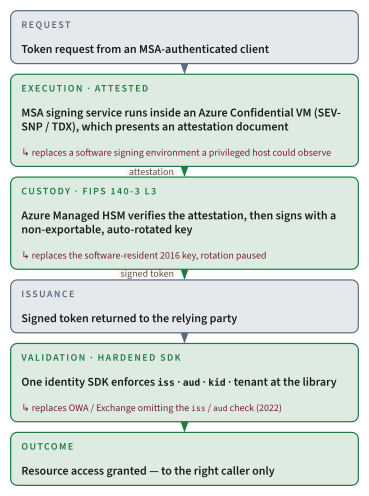
The architectural response addresses each of the four failure modes one-for-one. The lesson for the rest of the industry is not "use Microsoft's exact products." It is the control shape: keep signing keys non-exportable; rotate them automatically; bind signing operations to attested execution; make validation libraries fail closed on issuer and audience; make detection logs baseline features rather than premium features; and rehearse the emergency in which a signing key has to be retired before every cache in the ecosystem naturally expires. If those controls are not named, owned, and exercised before a key theft, they will be invented under pressure after one.
But how does this stack against what other major cloud providers publicly document?
How other cloud providers custody signing keys
The Storm-0558 attack class is generic. Any identity provider that signs tokens can in principle have its signing key stolen. The honest cross-provider comparison is therefore not "which provider is most secure": the public evidence does not support a defensible ranking. It is instead "which architectural property each provider publicly attests to having" for the keys behind its own production identity tokens. In the table, "not publicly disclosed" means not found in the cited public documentation, not proof that the control is absent.
The asymmetry of the table below is itself informative. Microsoft, after Storm-0558, has the most explicit public commitments precisely because it had the most public incident.
| Property | Microsoft (post-SFI) | AWS (IAM Identity Center, Cognito) | Google (Workspace, Cloud Identity) | Okta |
|---|---|---|---|---|
| HSM custody for production IdP signing keys | Yes: Azure Managed HSM, FIPS 140-3 Level 3 [1340, 1341] | Not publicly disclosed for IdP keys; CloudHSM is a customer primitive [1371, 1372] | Not publicly disclosed for IdP keys; Cloud HSM is a customer primitive [1345] | Not publicly disclosed at this granularity |
| Confidential Compute for signing operations | Yes: MSA on Azure Confidential VMs (Apr 2025); Entra ID in migration [1343, 1258] | Nitro Enclaves available as customer primitive; not publicly disclosed for IdP keys [1373, 1374] | Confidential Computing available as customer primitive; not publicly disclosed for IdP keys [1300] | Not publicly disclosed |
| Automatic rotation of IdP signing keys | Yes: MSA and Entra ID automatic rotation in Azure Managed HSM [1340] | AWS KMS default 365-day rotation for KMS keys; IdP rotation cadence not publicly disclosed [1346] | Cloud KMS rotation customer-controllable; Google-owned-and-managed model is opaque to customers [1345]; Workspace SAML cert rotation is admin-driven [1347] | Not publicly disclosed |
| Tenant/issuer separation enforced in SDK | Hardened identity SDK validating 90% of Entra ID Microsoft-app tokens (Apr 2025) [1343, 1324] | aws-jwt-verify library enforces iss/aud for Cognito tokens [1375, 1376] | Tink library architecture supports key-set discipline [1348] | Not publicly disclosed |
| Free customer audit logging | MailItemsAccessed plus 30+ event classes free since Sep 2023; 2-year internal retention [1326, 1343] | Standard CloudTrail; per-service audit varies | Workspace audit log; Cloud Audit Logs | System Log; baseline included |
| Public IdP-signing-key-class incident disclosure | Yes: Storm-0558 (Jul 2023) and CSRB report (Apr 2024) [1316] | None in 2023-2026 security bulletins surveyed [1349] | None in 2023-2026 security bulletins surveyed [1350] | October 2023 support-system breach; HAR-file session tokens; no IdP-signing-key compromise [1377, 1378] |
| Customer detected before vendor notified | Yes (State Department detected Jun 15, 2023, notified Microsoft Jun 16, 2023 [1316] | ) | ( | Yes) Cloudflare detected Oct 18, 2023, contacted Okta before vendor notification [1351] |
The asymmetric-disclosure norm.
The right reading of the empty cells in this table is not "AWS and Google are safer than Microsoft." It is "AWS and Google have not publicly disclosed an incident that would force this level of architectural commitment, so we do not know." The Wiz Research framing applies cross-provider: "if a signing key for Google, Facebook, Okta or any other major identity provider leaks, the implications are hard to comprehend" [1322]. Absence of public disclosure is not absence of risk; it is absence of forced disclosure. Microsoft's transparency, post-CSRB, is the comparison standard not because Microsoft is uniquely vulnerable but because Microsoft has uniquely published.
Side note.
The Okta October 2023 incident is worth knowing about as a cross-vendor data point precisely because of the structural parallel. On October 18, 2023, Cloudflare detected attacker activity that traced back to Okta and contacted Okta before Okta had notified Cloudflare. BeyondTrust had notified Okta on October 2; the attacker still had access until October 18. Okta's November 3 RCA traced the root cause to a service-account credential stored in an Okta employee's personal Google account [1377, 1378, 1351]. Different attack class (support-system access, HAR-file session tokens, not IdP signing keys), but the same vendor-detected-by-customer detection inversion the Storm-0558 story made famous.
For a CISO evaluating any IdP vendor, the four operational questions mapped to the four pre-incident failure modes above give a structured RFP. Where is the signing key custodied, and what FIPS certification does the HSM hold? What is the rotation cadence, and is rotation automated? Does the vendor's validation SDK enforce iss/aud separation by default, or does it leave the check to the caller? What audit log events are available to free-tier customers, with what retention?
CSA's Cloud Controls Matrix (CEK and IAM domains) and FedRAMP High SC-12 and IA-5 controls together cover most of these in standardized form, but CAIQ answers remain vendor self-assessments rather than per-operation proof [1379, 1380].
Theoretical Limits
There is one place where the architectural improvements of the architectural response stop. The Storm-0558 threat class lives downstream of a cryptographic identity, and there are limits cryptography itself imposes on what any architecture can do.
1 The core asymmetry
Under the standard cryptographic security notion of existential unforgeability under chosen-message attack (EUF-CMA, first formalized by Goldwasser, Micali, and Rivest in 1988 [1352]) a signature produced by a private signing key sk on a message m is, to any holder of the corresponding verification key vk, indistinguishable from one produced by the legitimate signer. This is not a deployment weakness. It is the definition of "signature." If the verifier could distinguish, the scheme would fail the security property. Formally [1352, 1353]:
where is the set of messages the adversary queried to the signing oracle. The adversary's only path to forging a verifying signature on a fresh message is to learn sk. Once it has sk, every signature it produces is, by construction, valid.
Definition, EUF-CMA (and sEUF-CMA).
EUF-CMA, existential unforgeability under chosen-message attack, is the standard security definition for digital signature schemes. The notion was formalized by Goldwasser, Micali, and Rivest in their 1988 SIAM Journal on Computing paper "A Digital Signature Scheme Secure Against Adaptive Chosen-Message Attacks" [1352]; the canonical modern openly-accessible textbook treatment is Chapter 13 of Boneh-Shoup's A Graduate Course in Applied Cryptography, which presents the game-based definition used throughout this section [1353]. Informally: an adversary with access to a signing oracle cannot produce a valid signature on a message it has not previously queried, except with negligible probability. The stronger sibling, sEUF-CMA (strong EUF-CMA), additionally forbids producing a new signature on a previously-queried message. Both notions imply that, once the private signing key is leaked, the legitimate signer can no longer be distinguished from the holder of the key by any signature-verifying party. This is what makes signing-key theft so consequential, and is precisely the assumption that the relying-party-side iss/aud enforcement of RFC 8725 Sections 3.8 and 3.9 is designed to compensate for when validation, not cryptography, is the only remaining line of defense [1324].
The consequence for defenders is that all defensive advantage against signing-key-forgery attacks lives outside cryptographic verification. The seven methods cataloged in the architectural response: HSM custody, Confidential Compute, automatic rotation, tenant/issuer separation, free audit logging, customer-verifiable attestation (mostly absent at major-CSP scale), and detection by kid/issuer drift. Are a practical taxonomy of the public levers defenders can use against a key whose theft is, after the fact, indistinguishable from legitimate use.
2 The CSP-monoculture residual
When the identity provider is a multi-tenant cloud service provider, the customer cannot independently audit the provider's key custody. The customer can demand SOC 2 reports, ISO certifications, and CSA CAIQ answers. SOC 2 and ISO involve third-party audit or certification, while CAIQ is a vendor self-assessment; none is a per-operation cryptographic proof that the signing key the provider used to sign a given token is the one custodied as advertised.
Customer-side detection of a CSP-side custody failure is possible; source-side probability reduction remains with the CSP that holds the key. The CSRB called this systemic risk out explicitly in its discussion of cloud-identity infrastructure [1316].
Key idea.
Customer-side prevention of a CSP-side custody failure is impossible by construction. Customer-side detection is possible. Prevention sits entirely on the CSP side. This is the asymmetry the Storm-0558 incident made visible.
3 The Microsoft-as-Storm-0558-victim recursion
There is a recursive aspect to Microsoft's position that is worth naming honestly. Microsoft sells controls (HSM custody, Confidential Compute, hardened SDKs, audit logging) intended to defend against the attack class Microsoft itself was the highest-profile victim of. Brad Smith's "without equivocation" framing acknowledged the recursion implicitly. The CSRB's framing was harsher: a corporate culture that "deprioritized enterprise security investments and rigorous risk management" was, in the Board's view, what allowed the recursion to obtain [1316, 1333].
4 The upper bound
The aggregate of HSM custody, Confidential Computing, automatic rotation, and tenant/issuer separation raises the attacker's required compromise from "find a key in a debugging artifact" to "simultaneously compromise the Confidential VM build pipeline, do so within the rotation window, and bypass the HSM access control or extract a per-key signing oracle." Each is individually possible. Jointly they are several orders of magnitude harder than the pre-Storm-0558 baseline. This is not a theoretical proof of security; it is empirical defense in depth.
Why customers can detect but not prevent CSP-side custody failure.
Imagine the cleanest possible customer-side defense. The customer subscribes only to providers that publish FIPS 140-3 Level 3 certifications, audit reports, and CAIQ answers. The customer pins acceptable issuers in their relying-party validators. The customer monitors for kid drift in tokens. Each of these reduces the detection latency for a CSP-side compromise. None of them reduces the probability that the CSP's signing key gets stolen tomorrow. Probability reduction at the source sits entirely on the CSP side, because the signing key by construction lives there.
Defense in depth defeats plausible paths. Whether it defeats the actual path is unknown: because the actual Storm-0558 key-acquisition path remains unknown in the public record.
Open Problems
Six open problems remain after three years, in descending order of architectural consequence.
OP1: The mechanism gap. Microsoft still does not publicly know how the 2016 MSA signing key was stolen. The methods above defeat plausible paths, but the actual path is undocumented. Until the actual mechanism is recovered (if it ever is), Microsoft is in the position of having raised the bar against the categories of attack it suspects, without being able to confirm that the bar it raised is the one the attacker cleared [1316, 1208].
OP2: The broader-blast-radius question. Wiz Research showed the same key could in principle have signed tokens for SharePoint, Teams, OneDrive, and many third-party "Sign in with Microsoft" applications. Whether the broader scope was exploited and went undetected against telemetry that never existed is unanswered [1322].
OP3: CSP regulation as critical infrastructure. The CSRB report framed cloud-identity-provider regulation as an open U.S. policy question. The Board recommended treating identity infrastructure as critical infrastructure subject to mandatory disclosure and minimum security baselines. Implementation across Congress, the executive branch, and sector-specific regulators is incomplete [1316].
OP4: Cross-provider unrotated-signing-key risk. No major non-Microsoft IdP publicly discloses signing-key rotation cadence for its production tokens. Microsoft's transparency post-CSRB is, at present, the publication standard; AWS's, Google's, and Okta's positions are inferred from product documentation rather than disclosed in the form Microsoft now uses [1372, 1345].
OP5: Threshold or multi-party signing for production IdP signing keys. Practical cryptographic protocols exist. The canonical Schnorr-class construction is FROST ("Flexible Round-Optimized Schnorr Threshold Signatures") introduced by Chelsea Komlo and Ian Goldberg at SAC 2020 [1354] and standardized as IRTF/CFRG RFC 9591 in June 2024 (a two-round protocol with five normative ciphersuites covering Ed25519, ristretto255, Ed448, P-256, and secp256k1) [1355].
For ECDSA, Yehuda Lindell and Ariel Nof's CCS 2018 paper described what its abstract called "the first truly practical full threshold ECDSA signing protocol that has both fast signing and fast key distribution" [1356]. The DKLs line (Doerner, Kondi, Lee, shelat) extended the work, with the May 2023 update "Threshold ECDSA in Three Rounds" the current standard reference, accompanied by named third-party production implementations from Coinbase, Silence Laboratories, Taurus Group, and BlockDaemon [1357].
No major cloud service provider has publicly deployed threshold signing for production IdP keys at the scale where compromise of a single signing oracle still ends the conversation. This is the largest unrealized research-to-practice gap in the entire stack.
OP6: Customer-verifiable attestation of IdP key custody. No standardized cryptographic primitive analogous to Certificate Transparency exists for IdP signing-key state. The design pattern was specified by Ben Laurie, Adam Langley, and Emilia Kasper (all of Google) in RFC 6962 in June 2013: a Merkle-tree-backed append-only log of TLS certificate issuance that lets any customer cryptographically detect that a certificate authority issued a certificate for their domain that they did not request [1358]. There is no equivalent primitive that lets a customer cryptographically detect that a token issuer signed a token naming them as sub that they (or their identity provider) did not request. This is the architectural ceiling of customer-side defense.
Side note.
OP5 and OP6 both have rich primary-source literatures this chapter only gestures at. For OP5, follow the original FROST paper [1354] for the security proof reducing to discrete log via the Bellare-Neven Generalized Forking Lemma, the corresponding IRTF specification [1355] for the deployable ciphersuites, Lindell-Nof's CCS 2018 paper [1356] for the threshold-ECDSA foundation, and the DKLs project page [1357] for the most recent three-round construction. For OP6, RFC 6962 [1358] specifies the Merkle-tree-backed append-only log structure (the Signed Certificate Timestamp, the Merkle Audit Path, and the Merkle Consistency Proof) that any future IdP-key-custody-transparency protocol would build on.
Research vs policy.
OP1, OP5, and OP6 are research-grade open questions in cryptographic systems design. OP2, OP3, and OP4 are policy and disclosure questions, addressable through regulation or industry-coordinated transparency norms. None has a published, deployed answer.
Three research-grade gaps, three policy-grade gaps. The defender, meanwhile, has to ship something on Monday. What should that something be?
What a Defender should do today
The practical guidance splits along three audiences: M365 customers operating the consumer side of this incident's geometry, builders of multi-tenant SaaS that signs JWTs of their own, and CISOs evaluating cloud identity vendors.
1 For Microsoft 365 customers
First, confirm Purview Audit is enabled at the highest tier your SKU permits, that MailItemsAccessed is being collected, and that the events are being forwarded to a SIEM with retention of at least 180 days. The features previously gated on Premium have been free for FCEB and most commercial customers since the September 2023 rollout [1326, 1327].
Second, maintain an inventory of legitimate (AppID, ClientAppID) pairs that historically read mailboxes in your tenant, and alert on any deviation. The State Department detection is reproducible only if you have collected the events to detect with.
Defender's minimum stack (M365).
- Purview Audit at the highest tier your SKU permits, with
MailItemsAccessedcollection enabled. - SIEM forwarding with at least 180 days of retention (Microsoft's new default), preferably longer.
- A maintained baseline of legitimate
(AppID, ClientAppID)pairs for mailbox access. - Alerts on anomalous mailbox access patterns; where your own applications or proxies expose token claims, add cross-issuer checks there.
- Routine threat-hunting against
MailItemsAccessedevents filtered by anomalous source IPs, working-hours patterns, and bulk-fetch behavior consistent with exfiltration [1325].
A companion rule for services you operate or telemetry you actually receive (not a standard assumption for Exchange Online first-party validation) is kid drift detection, expressed compactly:
2 For builders of multi-tenant SaaS that signs JWTs
If you sign JWTs yourself, you are operating an identity provider, and the Storm-0558 lessons apply to you directly. The checklist is six items.
- HSM custody for signing keys (M1). Generate signing keys inside an HSM with
exportable=False. The HSM signs; the application asks. The key never leaves. - Automatic rotation (M3). Rotate signing keys on a cadence measured in days to weeks. Publish the new
kidin your JWKS before signing with it; deprecate the oldkidonly after relying parties have had time to refresh their JWKS caches. - Issuer and audience enforcement (M4). Implement the combined
issandaudvalidation mandate RFC 8725 codifies in Sections 3.8 and 3.9, and test it with adversarial cross-tenant tokens. Write a test that forges a token from your tenantAand verifies that your tenantB's validator rejects it [1324, 1366]. kiddrift monitoring (M7). Alert on JWT validation events whosekidis not currently published in your issuer's JWKS. A forged token signed with a retired or unpublishedkidwill surface here.- JWKS cache invalidation discipline. Relying parties cache JWKS aggressively. Coordinate rotation with your largest relying parties; document the cache TTL you expect them to honor. OpenID Connect Discovery 1.0 specifies the JWKS discovery pattern but leaves cache TTL as a deployment choice; the publication of that contract is yours to make [1359]. Storm-0558's lesson is that an unrotated key is a permanent attack surface; a poorly-coordinated rotation is a permanent operational outage.
- An on-call runbook for rotation failure. If automatic rotation fails, what is the page severity? Who is paged? How is manual rotation performed? Microsoft's 2021 pause of MSA manual rotation (after a manual-rotation-related outage) is the cautionary tale; the runbook is the prevention [1316].
For higher-value deployments, add Confidential Compute (M2). Run the signing service inside an attested TEE so that even host operators cannot read the in-use key. The threshold of "higher-value" is whatever value of "your customer's most sensitive resource accessed by a forged token" makes the in-use observation residual worth closing.
Builder's minimum stack (multi-tenant SaaS that signs JWTs).
HSM custody plus automatic rotation plus RFC 8725 Sections 3.8 and 3.9 enforcement plus kid drift monitoring plus rotation runbook. Add Confidential Compute for the in-use observation residual on high-value paths. Test cross-tenant token rejection adversarially; do not trust your validation library defaults [1324, 1366, 1340].
3 For CISOs evaluating a cloud IdP
The four RFP questions, mapped to the four pre-incident failure modes cataloged above:
(a) Where is the signing key custodied, and what FIPS certification does the HSM hold?
(b) What is the rotation cadence for the IdP signing keys, and is rotation automated end-to-end?
(c) Does the validation SDK enforce iss/aud separation by default, or does it leave the check to the caller?
(d) What audit log events are available to free-tier customers, with what retention, and which events are gated behind paid tiers?
Map the answers to CSA CCM CEK and IAM domains and FedRAMP High SC-12 and IA-5 controls for cross-vendor normalization [1379, 1380].
A useful follow-up question once you have answers.
Ask the vendor: "If your production IdP signing key were stolen today, by what telemetry would you detect it, and within what time? What public-disclosure timeline would you commit to?" The answer reveals more about the vendor's posture than the answers to the four primary questions, because it forces the vendor to talk about a scenario their marketing material does not.
Key idea.
Defense in depth defeats the plausible attack mechanisms. Whether it defeats the actual attack mechanism is unknown because, in the highest-stakes documented case, the actual mechanism is still unknown. The defender's posture is therefore "raise the floor against everything I can imagine," not "patch the specific bug." Storm-0558's enduring lesson is what it means to architect under that constraint.
The seven SOTA methods raise the floor against plausible mechanisms. The customer can demand documentation, alert on deviations, enable the audit telemetry they actually need, and vote with procurement dollars for vendors whose disclosure posture matches Microsoft's post-CSRB stance. Prevention against a CSP-side custody failure remains, as the theoretical-limits discussion argued, on the CSP side.
Closing the chain
Storm-0558 is where the book's chain stops being an abstraction. Silicon can measure firmware and sign the measurement (Chapters 4 and 5); firmware can launch a kernel constrained by virtualization; VBS can isolate secrets (Chapter 6); Credential Guard can move reusable credentials outside ordinary lsass.exe (Chapter 15); Kerberos and cloud token systems can narrow who may speak for whom (Chapters 17 and 26); CAE can shorten the life of a session after risk changes (Chapter 27). None of those links is wasted when the cloud signing key is stolen. They still reduce the attacker paths below them. But none of them can rescue a relying party that accepts a forged sentence from the wrong issuer as if it were the truth.
That is the uncomfortable finale: trust chains do not fail only where they are weakest. They fail where an assumption crosses a boundary without being rechecked. The MSA key belonged to one authority. The enterprise mailbox belonged to another. The common host name, common metadata shape, and valid signature made the two feel adjacent enough for software to treat them as one. The attacker did not need to defeat RSA. The attacker needed the system to forget which promise RSA had actually made.
The finale's lesson is not despair. It is precision. Every link must say what it proves and what it does not. A TPM quote (Chapter 5) does not prove a cloud issuer was honest. A valid JWT signature does not prove the issuer was authorized for the resource. A log line does not prevent a breach, but without it the breach may never become knowable. A rotation runbook does not make keys immortal; it makes stale trust visible before stale trust becomes historical evidence. Trust chains fail when one link silently inherits more authority than the previous link was meant to grant.
So the closing discipline is five verbs. Isolate the secret so theft is not a file copy. Rotate the authority so yesterday's key cannot become next decade's skeleton key. Narrow the validator so a valid signature from the wrong issuer is still rejected. Record the event so the downstream defender can see what the upstream system missed. Explain the failure publicly enough that the rest of the ecosystem can test whether it shares the same shape.
When the chain snaps, the repair is the same discipline this book has followed from the first transistor boundary to the last cloud token: isolate the secret, narrow the validator, rotate the authority, record the event, and assume that the first person to see the break may be downstream from you. That is the whole silicon-to-cloud argument in one incident. The chain is never unbreakable. It is only defensible when every link is small enough to reason about, hard enough to steal, narrow enough to reject the wrong claim, and visible enough to prove what happened after the elegant assumptions fail.
And what this finale cannot close, it hands forward: not as failure, but as the argument's open edge. How the 2016 key was stolen is still unknown. Threshold signing and a Certificate-Transparency-style proof of key custody are still unbuilt. Whether the broader blast radius was ever exploited is still unanswerable against telemetry that never existed. Those residuals have no next chapter to inherit them, so they are gathered in the back-matter Unfinished Chain, where every chapter's open problems converge. The chain you have followed from the first transistor boundary to the last cloud token is not finished; it is handed to you, with the single discipline that outlives every link in it: never let a link inherit more authority than the link below it was meant to grant, and when it does, isolate, rotate, narrow, record, and explain until the inheritance is undone.